
The four basics of exchange office accounting
Account, voucher, debit and credit, currency, and the balancing rule - the four words the whole of Nexto is built from, explained without bookkeeping jargon.
Watch this video on: YouTube
Nobody opens an exchange office because they enjoy bookkeeping. But four words come back on every page of Nexto, and if you are vague about them you will spend the rest of this course guessing: account, voucher, debit and credit, currency. Add one rule - the balancing rule, which says no money goes missing and no money comes out of thin air - and you have the whole model.
None of this needs accounting training. They are plain definitions, and they explain every document you will ever book. This episode is done on paper; the software starts in the tour of the interface.
What you will learn
- Why a customer, a cash box and office rent are all the same kind of thing in Nexto
- Why a balance is a number plus a direction
- What a voucher is and what one looks like inside
- The one-line rule for debit and credit, with a worked example
- Why an unbalanced voucher can never be saved, and what the reference currency is for
The first basic: the account
Anything that carries a balance
An account means any party you keep books with. A customer is an account. So is a partner exchange, your cash box, your bank account, your Tether (USDT) wallet - even office rent.
Why are all of those the same thing? Because each carries a balance that goes up and down. That is the whole test: if it carries a balance, in Nexto it is an account.
A balance has a direction
A balance is not just a number. Debit means he owes you; credit means you owe him.
Take one customer through a deal. He has handed you US Dollars and has not taken his Iranian Toman yet: he is in credit, because he has a claim on you. Once he has taken the Toman and not yet delivered the Dollars, that same customer is in debit. Same person, opposite direction.
So read both parts of a balance: the figure, and the side it sits on.
The second basic: the voucher
Anything that changes balances
A voucher is anything that changes balances. A trade, a transfer, an expense, a cleared cheque - the names differ, but they all do the same job: they move balances around.
Every voucher carries a unique number, and that number is what you call it by everywhere: in search, on a statement, in a WhatsApp message to a customer.
What one voucher looks like inside
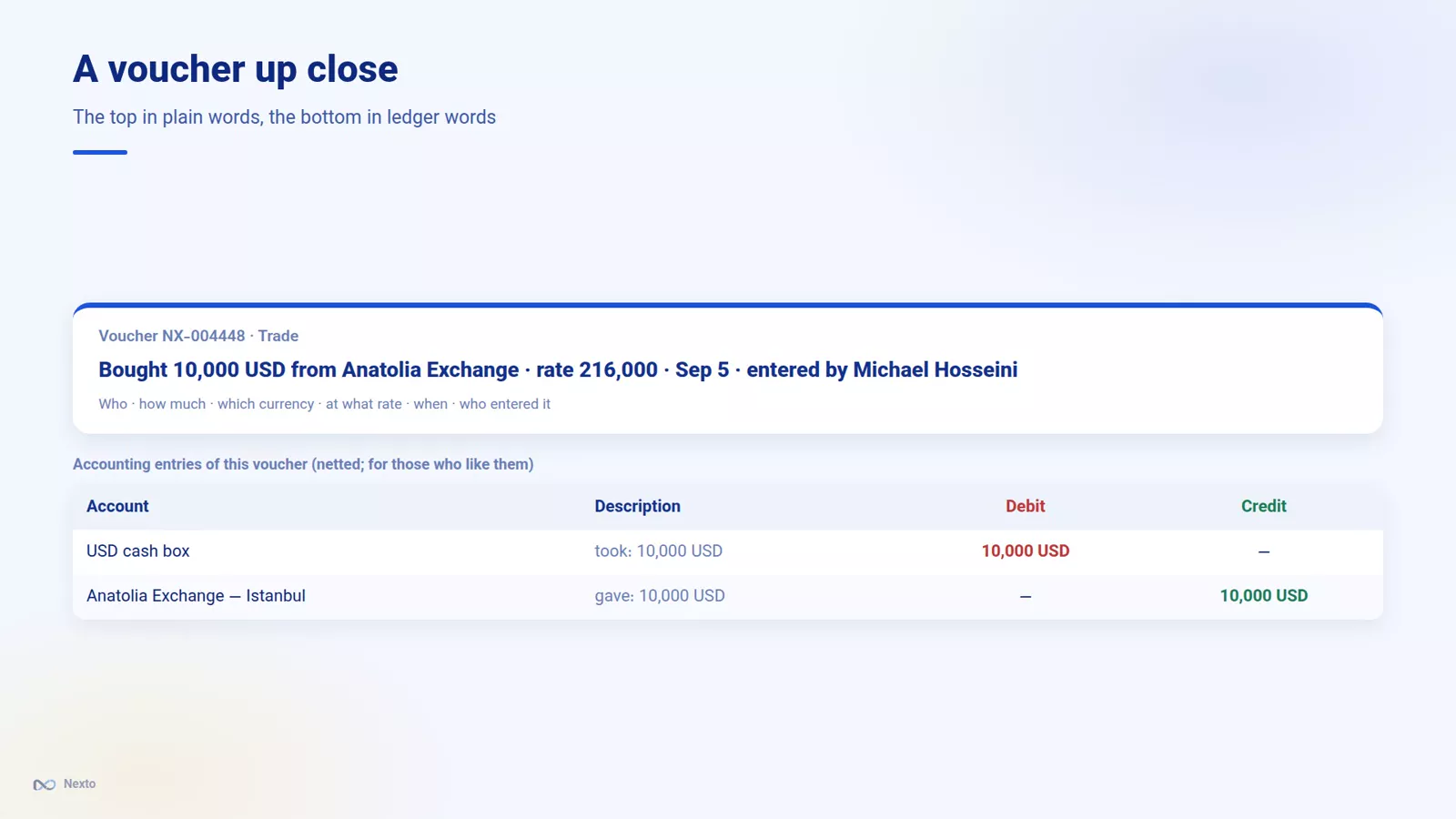
Open a voucher and you get two layers.
At the top, the plain-language summary: who, how much, which currency, at what rate, when, and who booked it. That is the layer you work with day to day.
At the bottom, collapsed out of the way, sit the accounting entries: the same voucher in the language of the ledger, usually in two lines. Most days you will not open it; it is there so that whenever you want to see what happened behind the scenes, you can. Every line there carries a figure either in the debit column or in the credit column, never both.
The third basic: debit and credit
The plain meaning first
This is the pair everybody is afraid of, and the fear is misplaced:
- A debtor is someone who took something and has not given it back, so he owes you.
- A creditor is someone who gave something and has not taken anything back, so he has a claim on you.
Every account has those two columns, debit and credit, and every voucher writes a figure into one of them.
The one-line rule
Whichever side receives something in a voucher is debited; whichever side gives something is credited. Received, debit. Gave, credit.
A worked example
The same example comes back in buying and selling currency. Persepolis Exchange hands you 10,000 US Dollars and has taken nothing back yet.
- Which side gave? Persepolis. So their account goes to credit: they hold a claim on you for 10,000 US Dollars.
- Which side received? Your US Dollar cash box. So the box goes to debit: 10,000 US Dollars are now sitting in it.
- Now you pay out the Toman. The Toman box gave, so it goes to credit.
- Persepolis received, so their account goes to debit, and their Dollar claim comes up against their Toman debt.
Every voucher you meet in this course is built the same way.
The rule: every voucher balances
Why it can never be off
In every voucher one side received and one side gave, so the total of the debit column and the total of the credit column are always the same figure. That is what it means to say a voucher balances.
And when every voucher balances, the whole ledger balances: all the debits added up match all the credits added up. In practice that means one thing - no money has gone missing, and none has come out of thin air. Nexto will not accept an unbalanced voucher; when it refuses one, that is a guard, not fussiness.
The trial balance
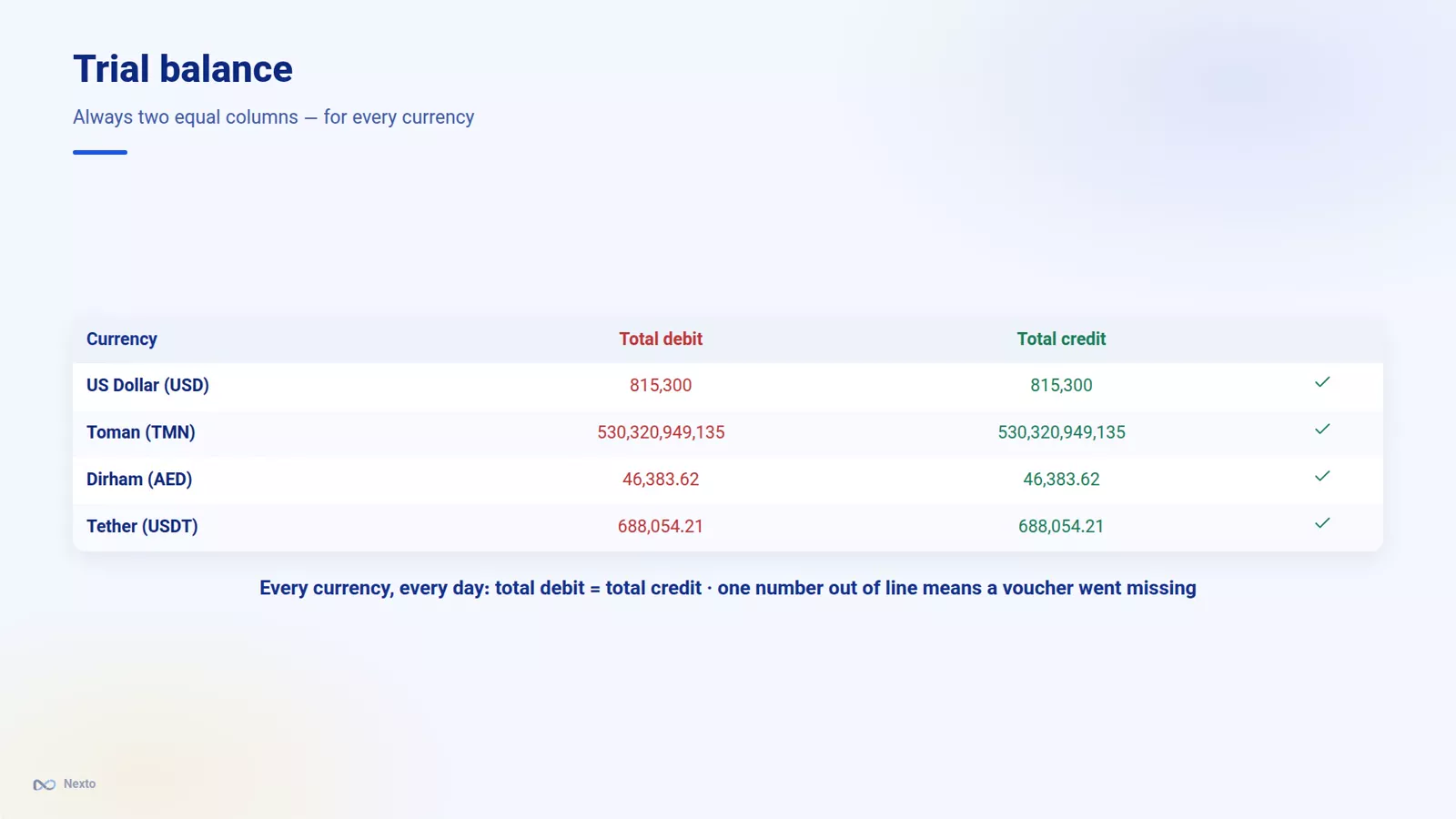
There is a report for exactly this: the trial balance. For each currency, two columns - total debit and total credit - always showing the same figure. If those two ever stopped matching it would mean a voucher had gone missing, which in Nexto cannot happen.
You never write entries yourself
Here is the part that matters most in daily work: you never write any of this by hand. You fill in the trade form - who, how much, which currency, at what rate - and Nexto builds both sides of the voucher on its own.
Debit and credit are explained here only so the words are not strangers when you meet them on a statement. Your job is to say who gave what and who received what.
The fourth basic: currency
Currency is the part that belongs specifically to exchange work. In Nexto every balance belongs to one particular currency; a balance with no currency on it means nothing.
One customer can be in credit in US Dollars and in debit in Iranian Toman at the very same time, and there is nothing wrong with that - it is what an exchange office does. Which is why balances appear per currency everywhere in Nexto, never as a single figure.
The reference currency
One currency among them is different: the reference currency. It is the unit everything is converted into when you want to see the whole picture at once - profit, the net of your balances, the balance sheet. For many exchange offices that is the US Dollar.
You choose it on day one, and once the first voucher has been booked it does not change any more. The reasons are covered in settings, currencies and your first users.
Putting it together
A voucher is booked. It moves two accounts. The side that received is debited, the side that gave is credited, and the two are always equal, so it balances - all of it in one currency, converted into the reference currency whenever that is needed.
That is the whole of Nexto; everything else is detail. If you get lost anywhere in this course, come back and ask: which accounts are involved, which voucher was booked, which side was debited, and in what currency.
Tips and warnings
- Never read a balance without its direction. "Five thousand" is not an answer; "five thousand in credit" is.
- Do not look for one balance figure for a customer dealing in several currencies. The balance is one figure per currency; the converted total is a management number.
- If Nexto refuses to save a voucher because it does not balance, something you entered is genuinely wrong. Do not look for a way around it.
- Pick the reference currency deliberately on day one. After the first voucher it is locked.
Where to go next
The previous episode, what Nexto is and the map of this course, covers what the software does and where to start. Next comes a tour of the interface, where these words first appear on screen. Then settings, currencies and your first users is where you choose the reference currency, and buying and selling currency puts the debit-and-credit example to work on a real trade.
FAQ
What counts as an account in Nexto?
Any party that carries a balance: a customer, a partner exchange, a cash box, a bank account, a Tether wallet, even an expense such as office rent. If it has a balance that moves, it is an account.
What is the difference between debit and credit?
Debit means the account owes you; credit means you owe the account. The rule inside a voucher is simple: the side that received something is debited, and the side that gave something is credited.
Why does every voucher have to balance?
Because in every voucher one side received and one side gave, so total debit always equals total credit. Nexto refuses to save a voucher that does not balance, which is what guarantees no money goes missing or appears from nowhere.
What is the reference currency for?
It is the single unit everything is converted into for profit, the net of your balances and the balance sheet. You choose it on day one and it is fixed once the first voucher is booked.
Full video transcript
Before you press a single button in Nexto, there are four words and one rule; if you get hold of them, the rest of this course becomes easy: account, voucher, debit and credit, currency — and the balancing rule, which says that no money goes missing and no money comes out of thin air. None of this needs bookkeeping training; they are just a few plain definitions that come back in every one of the thirty episodes after this one. We will do this episode on paper; you will see plenty of the software from the next one on.
The first one is the account. An account means any party you keep books with: a customer is an account, a partner exchange is an account, your cash box is an account, your bank account, your Tether wallet, even office rent is an account. Why are they all the same thing? Because they share one property: each of them carries a balance that goes up and down. If something carries a balance, in Nexto it is an account. And a balance has a direction: debit means he owes you, credit means you owe him.
A customer who has handed you dollars and has not taken his tomans yet is in credit; that same customer, once he has taken the tomans and not yet delivered the dollars, is in debit. A balance is not just a number; it is a number plus a direction. The second one is the voucher. A voucher means anything that changes balances. A trade is a voucher. A transfer is a voucher. An expense is a voucher. A cleared cheque is a voucher. Their names differ, but they all do the same job: they move balances around.
And every voucher carries a unique number that you call it by everywhere: in search, on a statement, in a WhatsApp message. Let us look at one voucher up close. At the top, the plain-language summary: who, how much, which currency, at what rate, when, and who booked it. And at the bottom, collapsed, the accounting entries: the same voucher in the language of the ledger, in two lines. You do not have to open it every time; it is there so that whenever you want, you can see exactly what happened behind the scenes.
The third one is the thing everybody is afraid of: debit and credit. First the plain meaning, with no bookkeeping in it: a debtor is someone who took something and has not given it back, so he owes you. A creditor is someone who gave something and has not taken anything back, so he has a claim on you. Now, in Nexto every account has two columns, debit and credit, and every voucher writes a number into one of those two columns. The one-line rule: whichever side receives something in a voucher is debited, and whichever side gives something is credited.
One example, the same one you will see again in the buying-and-selling episode. Persepolis Exchange hands you ten thousand dollars and has taken nothing back yet. Which side gave? Persepolis, so their account goes to credit: they hold a claim on you for ten thousand dollars. Which side received? Your dollar cash box, so the box goes to debit: ten thousand dollars are now sitting inside it. Now you pay out the tomans: the toman box gave, so it goes to credit; Persepolis received, so it goes to debit, and their dollar claim comes up against their toman debt.
Those two words explain every voucher you will meet in this course. Go back to that sample voucher. Every line carries a number either in the debit column or in the credit column. No line carries both: the side that received sits here, the side that gave sits there. And this is exactly where the balancing rule comes from. In every voucher one side received and one side gave, so the total of the debit column and the total of the credit column are always the same.
That is what we mean when we say a voucher balances. And when all the vouchers balance, the whole ledger balances: every debit added up matches every credit added up. What that means for you in practice: no money has gone missing and no money has come out of thin air. Nexto will not accept an unbalanced voucher; that is a guard, not fussiness. There is a report for precisely this: the trial balance. For each currency, two columns, total debit and total credit, and always the same figure.
If one day the two are not the same, it means a voucher has gone missing somewhere; which in Nexto cannot happen. And the good news: in Nexto you never write any of this yourself. You fill in the trade form — who, how much, which currency, at what rate — and the software builds both sides of the voucher on its own. We are telling you all this only so that they are not strangers when you come across them, and so you know Nexto is looking after the balancing itself; you only say who gave what and who received what.
And the fourth one: currency, the part that belongs to exchange work. In Nexto every balance belongs to one specific currency; a balance with no currency on it means nothing. One customer can be in credit in dollars and in debit in tomans at the very same time, and there is nothing wrong with that; that is precisely what an exchange office does. Which is why balances show up per currency everywhere in Nexto, and never as a single figure. And one currency among them is different: the reference currency.
It is the one everything is converted into when you want to see it all in a single unit — profit, the net of your balances, the balance sheet. For most exchange offices that is the dollar. You choose it on day one, and once the first voucher is booked it does not change any more; we will see why in the setup episode. Now put it all together: a voucher is booked, it moves two accounts, the side that received is debited and the side that gave is credited — always equal, so it balances — and all of it in one specific currency, converted into the reference currency whenever that is needed.
That is the whole of Nexto; everything else is detail. So if you get lost anywhere in this course, come back to these four words and ask: which accounts are involved here, which voucher was booked, which side was debited, and in what currency. The answer is always the same one.
Try it yourself right now
A complete private demo with sample data — no installation, no credit card.
Create free demo